
SAP Business One to NetSuite Data Migration
Outgrowing SAP Business One? Mine automates the mapping between SAP B1's SQL/HANA database and NetSuite's cloud architecture — preserving business partners, item masters, BOMs, pricing, and financial history.
Working with enterprise teams on active migration programs
3–6 weeks
to production-ready mappings
40–50%
cost reduction vs. manual migration
90%+
average mapping confidence
Most enterprise migrations start 6+ months behind schedule. Yours doesn't have to.
This guide is for VPs of IT, data architects, and migration leads at companies moving data from SAP Business One to Oracle NetSuite — whether you're scoping, planning, or mid-program.
SAP Business One stores data in tables like OCRD (Business Partners), OITM (Items), ITT1 (BOM components), OJDT (Journal Entries), and OINV/OPCH (AR/AP invoices) with User Defined Fields (UDFs) on most tables. NetSuite uses a cloud-native object model with Customers, Vendors, Items, BOM Revisions, and Journal Entries. Mine maps SAP B1's table schema to NetSuite's object model automatically, including all UDFs and custom queries.
Based on enterprise migration programs led by Mine's founding team
Last updated March 2026
How Mine automates your SAP Business One to Oracle NetSuite migration
Mine profiles SAP B1's OCRD table and automatically splits business partners into NetSuite Customer and Vendor records based on CardType — preserving addresses (CRD1), contacts (OCPR), and payment terms for each.
All User Defined Fields across B1 tables are profiled, analyzed for active data, and mapped to NetSuite custom fields with proper type translation — eliminating the manual UDF audit.
B1's pricing model (price lists, special prices, discount groups) is mapped to NetSuite's price levels and quantity pricing schedules, with pricing rules that require custom implementation flagged for the implementation team.
Mine generates the transformation logic for G/L account mapping, dimensional translation, and journal entry date filtering — so financial data migrates with proper segment assignments.
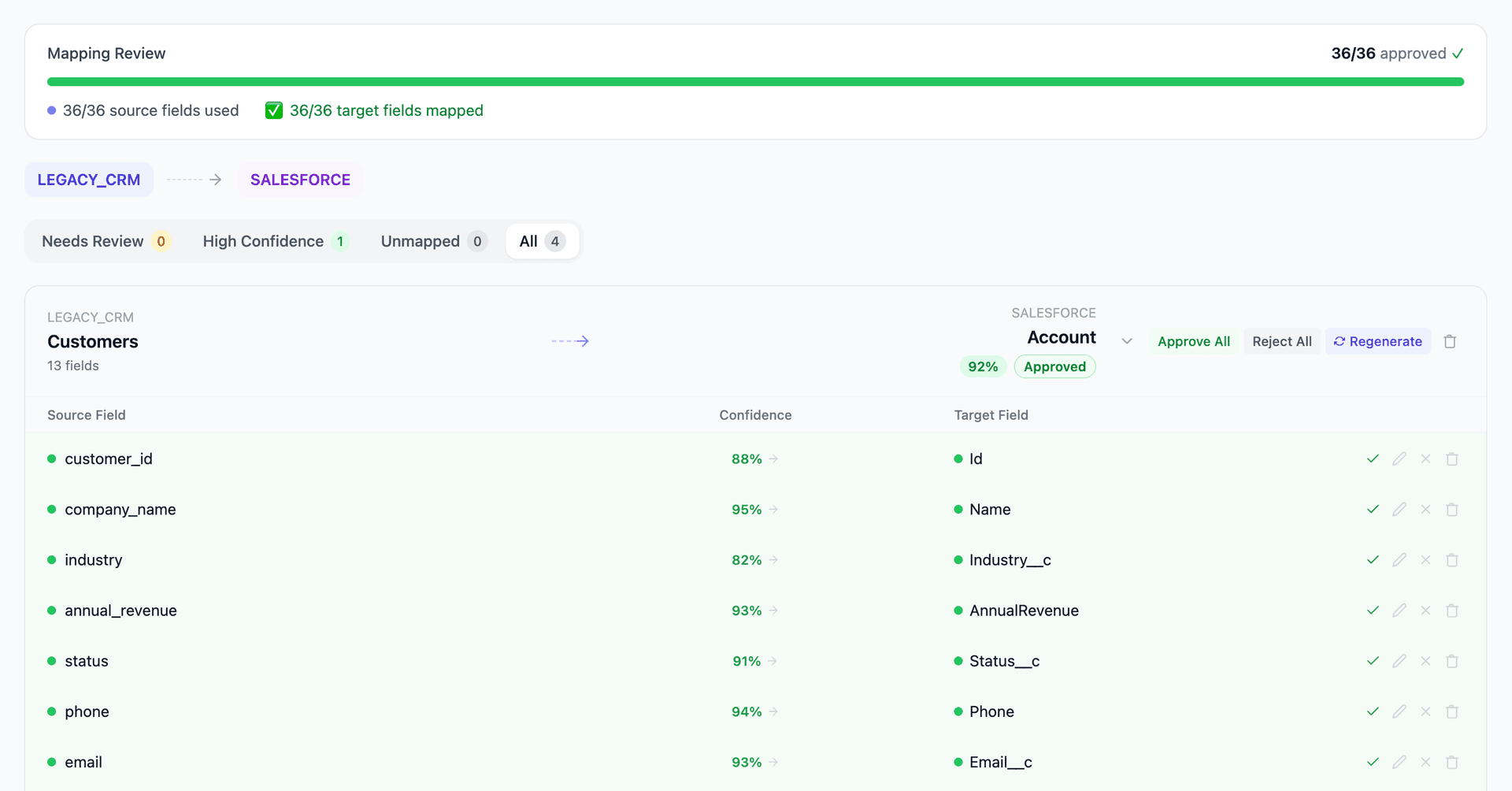
Get your SAP Business One to Oracle NetSuite mapping analysis — see results in under an hour
Migration timeline: manual vs. Mine
Traditional approach
Timeline
3–9 months
Estimated cost
$100K–500K
Team size
3–6 consultants
Typically requires
×Manual field mapping in spreadsheets
×Custom ABAP/SQL extraction scripts
×3–5 mock migration cycles
×Dedicated source system consultants
×Manual reconciliation testing
With Mine
Enterprise benchmarksTimeline
3–6 weeks
Team size
1–3 internal resources
Estimated cost
40–50% less
Included
✓Schema profiling & analysis
✓AI-generated field mappings
✓Transformation SQL
✓Validation & readiness reports
✓Production-ready load files
Common challenges migrating from SAP Business One to Oracle NetSuite
Business Partner split to Customer and Vendor
SAP B1 uses a unified Business Partner table (OCRD) with CardType field distinguishing customers (C), vendors (S), and leads (L). A single partner can be both customer and vendor. NetSuite requires separate Customer and Vendor records. Mine identifies dual-role business partners and generates both NetSuite records with proper cross-referencing, preserving billing/shipping addresses from CRD1 and contact persons from OCPR.
Explore related migrations →User Defined Fields and Tables
SAP B1 implementations use UDFs extensively — custom fields on OCRD, OITM, ORDR, and virtually every other table. These fields often contain critical operational data (custom pricing tiers, compliance flags, industry codes). Mine profiles every UDF, identifies which contain active data vs. obsolete values, and maps active fields to NetSuite custom fields with type translation.
Explore related migrations →Pricing and discount structure translation
SAP B1 uses price lists (OITM/ITM1) with quantity-based and volume-based discounts, special prices per business partner (OSPP), and discount groups. NetSuite uses price levels, pricing groups, and quantity pricing schedules. The pricing model differs structurally. Mine maps B1 price lists and discount structures to the nearest NetSuite equivalent and flags pricing rules that require custom implementation.
Explore related migrations →G/L account and cost center mapping
SAP B1 uses a chart of accounts (OACT) with profit centers and dimensions for cost allocation. NetSuite uses accounts with classes, departments, and locations as segments. The G/L mapping is straightforward but the dimensional model differs — SAP B1 dimensions must map to NetSuite segments, and every historical journal entry must carry the translated segment values.
Explore related migrations →Production BOM and routing to NetSuite Manufacturing
SAP B1's Production module uses BOMs (ITT1 for components) and Production Orders (OWOR) with a simpler manufacturing model than full SAP ECC. NetSuite's manufacturing module uses BOM records with revisions and Work Orders. Mine maps B1's BOM structure to NetSuite's format, translating component quantities, warehouse assignments, and production order status.
Explore related migrations →SAP Business One to Oracle NetSuite field mapping — what data moves
12 data objects typically migrated
| Source Object | → | Target Object |
|---|---|---|
| OCRD (Business Partners) | → | Customer / Vendor |
| OCPR (Contact Persons) | → | Contact |
| CRD1 (BP Addresses) | → | Customer/Vendor Address |
| OITM (Items) | → | Item |
| ITT1 (BOM Components) | → | BOM / BOM Revision |
| OWOR (Production Orders) | → | Work Order |
| ORDR / RDR1 (Sales Orders) | → | Sales Order |
| OPOR / POR1 (Purchase Orders) | → | Purchase Order |
| OINV / INV1 (AR Invoices) | → | Invoice |
| OPCH / PCH1 (AP Invoices) | → | Vendor Bill |
| OJDT / JDT1 (Journal Entries) | → | Journal Entry |
| ITM1 (Price Lists) | → | Price Level / Pricing |
Typical enterprise migrations include 500K–10M+ records across these objects. Mine handles profiling and mapping at any scale.
The cost of manual SAP Business One to Oracle NetSuite migration
SAP B1 partners and NetSuite implementation firms run these migrations over 3–9 months. The data conversion — mapping B1 tables to NetSuite objects, splitting business partners, restructuring BOMs, and migrating financial history — typically takes 4–10 weeks but can extend significantly when UDF complexity is high.
Frequently asked questions
Related migration paths
In one enterprise migration, a single field mapping error in customer master data caused $100K in billing discrepancies that went undetected for 6 months.
Mine catches these issues before they reach production.
Built by a team that led SAP, Oracle, and Salesforce data migration programs for Fortune 500 companies at a Big 4 consulting firm. Currently in design partnership with enterprise clients running active migration programs.
Ready to migrate from SAP Business One to Oracle NetSuite?
Tell us about your migration and we'll show you how Mine can help.
No commitment required. We'll review your migration scope and share a preliminary assessment within 48 hours.
You'll receive a preliminary mapping analysis showing how your source objects map to your target schema, with confidence scores and flagged risk areas.