
HubSpot to Dynamics 365 Data Migration
Consolidating on the Microsoft stack? Mine automates the mapping between HubSpot's property model and Dynamics 365's Dataverse entities — translating contacts, companies, deals, and engagement data.
Working with enterprise teams on active migration programs
2–4 weeks
to production-ready mappings
40–50%
cost reduction vs. manual migration
90%+
average mapping confidence
Most enterprise migrations start 6+ months behind schedule. Yours doesn't have to.
This guide is for VPs of IT, data architects, and migration leads at companies moving data from HubSpot to Microsoft Dynamics 365 — whether you're scoping, planning, or mid-program.
HubSpot uses a flexible property-based model with contacts, companies, and deals plus lifecycle stages and marketing automation, while Dynamics 365 uses Dataverse entities with stricter typing, business process flows, and deep Microsoft ecosystem integration. Mine translates HubSpot's marketing-first CRM model to D365's enterprise sales architecture.
Based on enterprise migration programs led by Mine's founding team
Last updated March 2026
How Mine automates your HubSpot to Microsoft Dynamics 365 migration
Mine routes HubSpot Contacts to D365 Leads or Contacts based on lifecycle stage — Subscribers and Leads become D365 Leads, SQLs and Customers become D365 Contacts with Account associations.
Properties are mapped to Dataverse fields with strict type translation — HubSpot's flexible properties get the correct Dataverse field type, precision, and option set configuration.
Deal pipelines are translated to D365 Opportunity stages with business process flow mapping — generating the BPF configuration to match your HubSpot pipeline structure.
Mine documents all marketing engagement data with recommendations — what migrates to D365 Marketing, what becomes custom entities, and what gets archived.
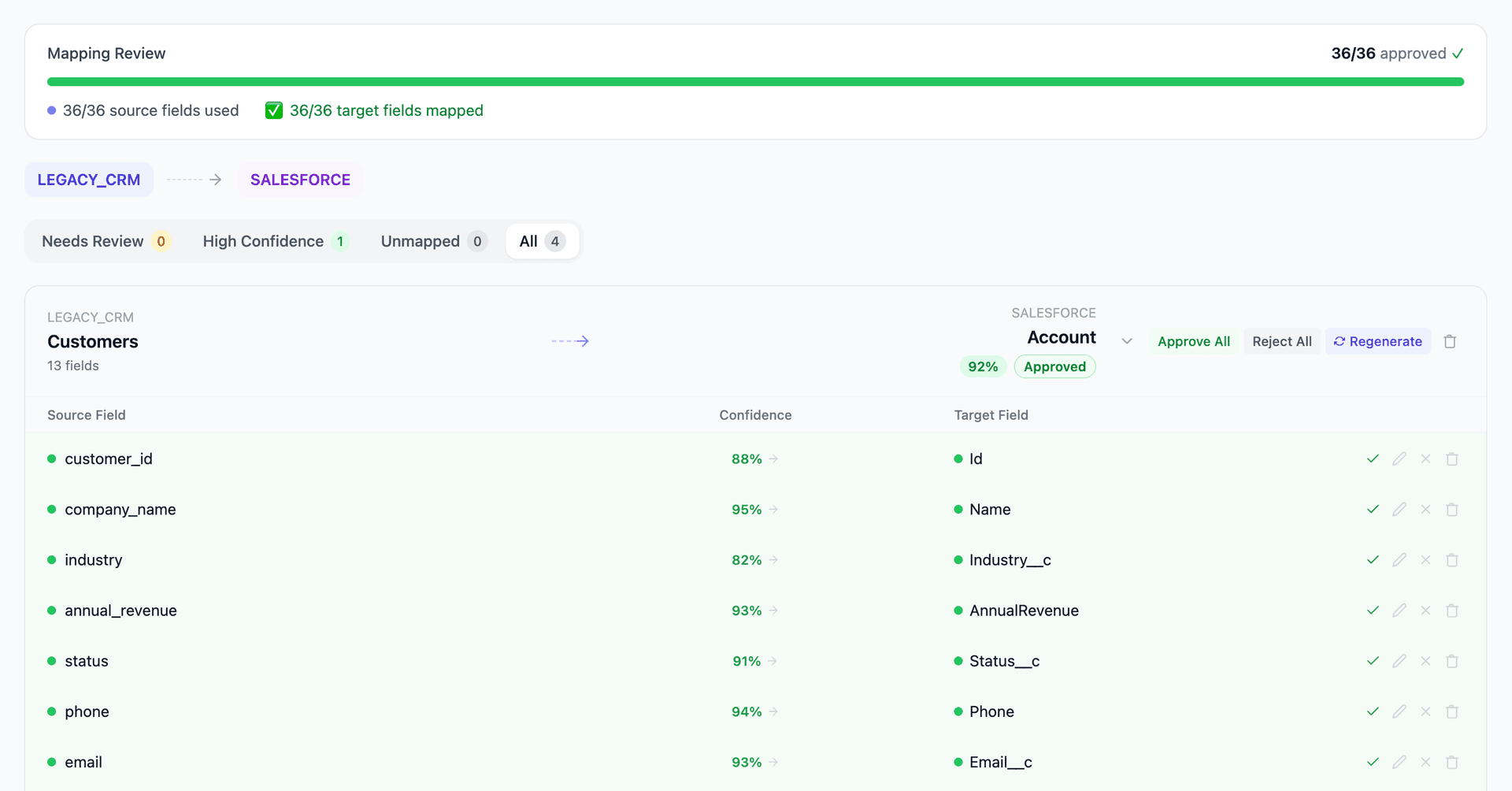
Get your HubSpot to Microsoft Dynamics 365 mapping analysis — see results in under an hour
Migration timeline: manual vs. Mine
Traditional approach
Timeline
2–4 months
Estimated cost
$100K–400K
Team size
2–4 consultants
Typically requires
×Manual field mapping in spreadsheets
×Custom ABAP/SQL extraction scripts
×3–5 mock migration cycles
×Dedicated source system consultants
×Manual reconciliation testing
With Mine
Enterprise benchmarksTimeline
2–4 weeks
Team size
1–2 internal resources
Estimated cost
40–50% less
Included
✓Schema profiling & analysis
✓AI-generated field mappings
✓Transformation SQL
✓Validation & readiness reports
✓Production-ready load files
Common challenges migrating from HubSpot to Microsoft Dynamics 365
HubSpot lifecycle stages to D365 business process flows
HubSpot uses lifecycle stages (Subscriber, Lead, MQL, SQL, Opportunity, Customer) to track progression. D365 uses business process flows (BPFs) that guide users through stages with cross-entity navigation. Mapping lifecycle stages to BPF stages — and deciding whether HubSpot Contacts become D365 Leads or Contacts — requires sales process design.
Explore related migrations →Property model to Dataverse typed fields
HubSpot properties are flexibly typed — a 'Number' property accepts any numeric value. Dataverse fields are strictly typed with specific decimal precision, currency handling, and option set configurations. Each HubSpot property needs Dataverse field type analysis, not just name matching.
Explore related migrations →Marketing engagement data
HubSpot tracks email opens, clicks, form submissions, page views, and content engagement natively. D365 Sales doesn't have native marketing engagement tracking (Dynamics 365 Marketing is a separate module). Engagement history may be archived, migrated to custom entities, or lost — depending on whether you're also adopting D365 Marketing.
Explore related migrations →Association model to Dataverse relationships
HubSpot uses associations (Contact-Company, Contact-Deal, Company-Deal) with flexible cardinality. Dataverse uses 1:N and N:N relationships with specific referencing patterns. HubSpot's labeled associations (e.g., 'Decision Maker' role on Contact-Deal) may need custom relationship roles in D365.
Explore related migrations →HubSpot to Microsoft Dynamics 365 field mapping — what data moves
9 data objects typically migrated
| Source Object | → | Target Object |
|---|---|---|
| Contact | → | Contact / Lead |
| Company | → | Account |
| Deal | → | Opportunity |
| Product | → | Product / Price List Item |
| Ticket | → | Case |
| Task / Meeting / Call | → | Activity (Task / Appointment) |
| Email engagement | → | Email / Custom entity |
| Note | → | Note / Annotation |
| Custom Properties | → | Custom Fields |
Typical enterprise migrations include 500K–10M+ records across these objects. Mine handles profiling and mapping at any scale.
The cost of manual HubSpot to Microsoft Dynamics 365 migration
Companies typically manage this during a D365 implementation using CSV exports from HubSpot and D365's data import wizard. The property-to-field mapping, lifecycle-to-BPF translation, and engagement history decisions require manual analysis.
Frequently asked questions
Related migration paths
In one enterprise migration, a single field mapping error in customer master data caused $100K in billing discrepancies that went undetected for 6 months.
Mine catches these issues before they reach production.
Built by a team that led SAP, Oracle, and Salesforce data migration programs for Fortune 500 companies at a Big 4 consulting firm. Currently in design partnership with enterprise clients running active migration programs.
Ready to migrate from HubSpot to Microsoft Dynamics 365?
Tell us about your migration and we'll show you how Mine can help.
No commitment required. We'll review your migration scope and share a preliminary assessment within 48 hours.
You'll receive a preliminary mapping analysis showing how your source objects map to your target schema, with confidence scores and flagged risk areas.