
Oracle EBS to Oracle Cloud Data Migration
Move from Oracle EBS to Oracle Cloud ERP (Fusion) with AI-powered data migration. Mine handles the FBDI template mapping, DFF conversion, and flexfield restructuring that make Oracle-to-Oracle Cloud migrations surprisingly complex.
Working with enterprise teams on active migration programs
6–10 weeks
to production-ready mappings
40–50%
cost reduction vs. manual migration
90%+
average mapping confidence
Most enterprise migrations start 6+ months behind schedule. Yours doesn't have to.
This guide is for VPs of IT, data architects, and migration leads at companies moving data from Oracle EBS to Oracle Cloud — whether you're scoping, planning, or mid-program.
Despite being the same vendor, Oracle EBS and Oracle Cloud use fundamentally different data architectures — Cloud requires data loading through FBDI (File-Based Data Import) templates with exact column structures, and EBS's Descriptive Flexfields must be converted to Cloud's different DFF framework. Mine generates correctly formatted FBDI files from EBS data automatically, handling the loading sequences and dependency chains.
Based on enterprise migration programs led by Mine's founding team
Last updated March 2026
How Mine automates your Oracle EBS to Oracle Cloud migration
Mine automatically generates correctly formatted FBDI templates from EBS data — handling column ordering, mandatory field defaults, and lookup value alignment for each Cloud business object.
EBS DFF context-segment combinations are profiled from the repository and mapped to Cloud DFF structures — with data value conversion rules generated for each context.
Chart of accounts value sets are converted to Cloud's tree-based hierarchy format with parent-child relationships derived from EBS segment value attributes.
Mine analyzes cross-object dependencies and generates the correct FBDI loading sequence — ensuring all setup data (payment terms, tax codes, UOM) loads and validates before transaction data imports.
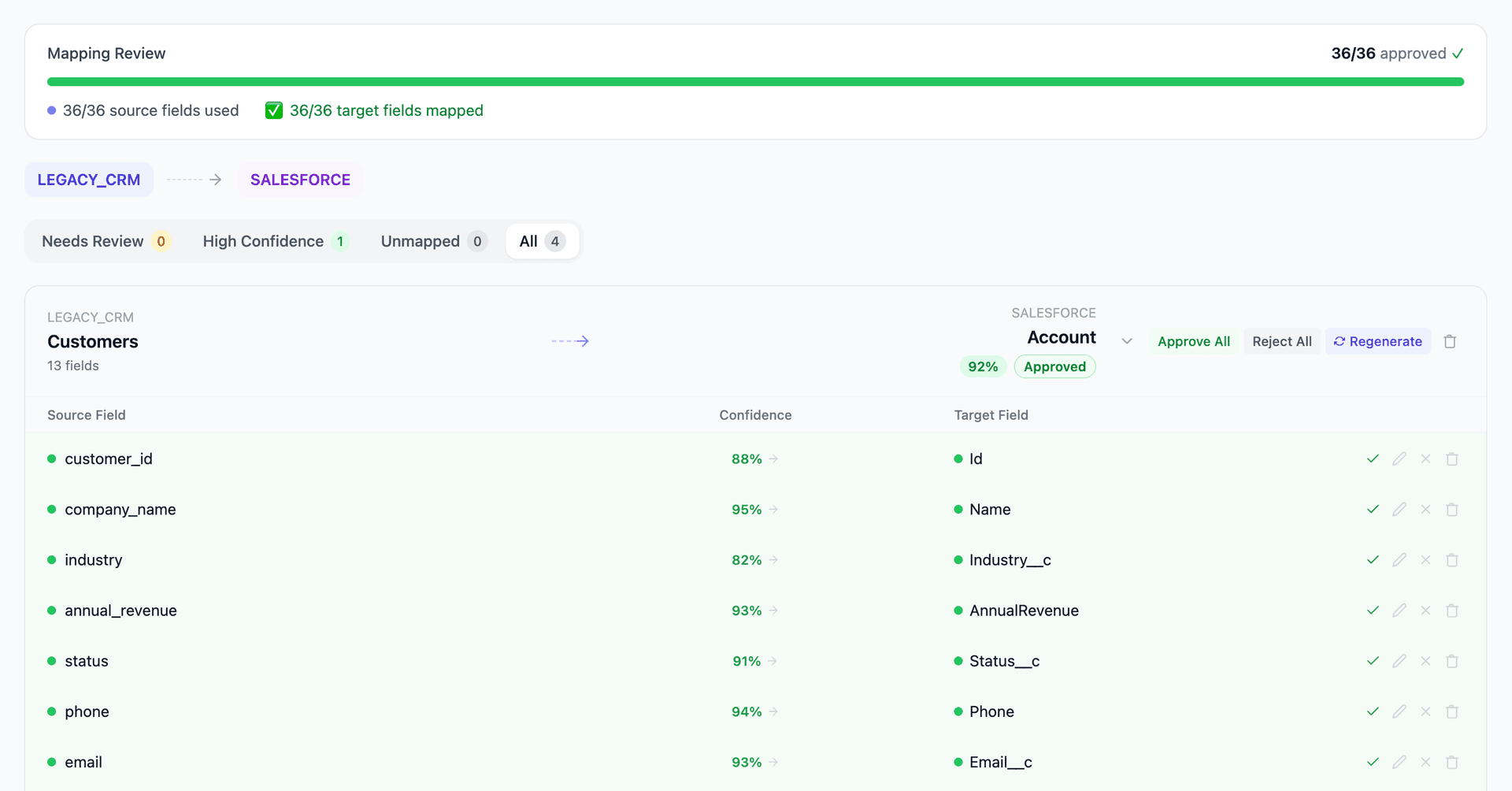
Get your Oracle EBS to Oracle Cloud mapping analysis — see results in under an hour
Migration timeline: manual vs. Mine
Traditional approach
Timeline
9–18 months
Estimated cost
$1M–4M
Team size
6–12 consultants
Typically requires
×Manual field mapping in spreadsheets
×Custom ABAP/SQL extraction scripts
×3–5 mock migration cycles
×Dedicated source system consultants
×Manual reconciliation testing
With Mine
Enterprise benchmarksTimeline
6–10 weeks
Team size
2–3 internal resources
Estimated cost
40–50% less
Included
✓Schema profiling & analysis
✓AI-generated field mappings
✓Transformation SQL
✓Validation & readiness reports
✓Production-ready load files
Common challenges migrating from Oracle EBS to Oracle Cloud
FBDI template formatting and sequencing
Oracle Cloud requires data to be loaded through FBDI (File-Based Data Import) templates — specific CSV formats with exact column ordering, mandatory fields, and lookup validations. Each business object (suppliers, customers, invoices, journals) has its own FBDI template with different rules. Generating correctly formatted FBDI files from EBS data requires precise transformation logic and loading sequences that respect cross-object dependencies.
Explore related migrations →Descriptive Flexfield (DFF) and global segment conversion
EBS DFFs use context-sensitive segments (ATTRIBUTE1–ATTRIBUTE15) whose meaning varies by context value. Oracle Cloud has its own DFF framework with different context structures and naming. Each EBS DFF context-segment combination must be mapped to the equivalent Cloud DFF or replaced with a Cloud extensible flexfield — and the data values converted accordingly.
Explore related migrations →Chart of accounts restructuring for Cloud segments
EBS uses accounting flexfield value sets with independent or dependent validation. Oracle Cloud uses tree-based hierarchies for each COA segment. The value set-to-tree conversion is non-trivial — parent-child relationships must be explicitly defined in Cloud's tree structure, and cross-validation rules must be recreated as Cloud segment rules.
Explore related migrations →Setup data migration before transaction data
Oracle Cloud requires all reference data (payment terms, tax codes, currencies, UOM, supplier sites, customer sites) to be loaded and validated before any transaction data can import. The sequencing is strict — a single missing setup record causes entire FBDI loads to fail. Identifying the complete setup data dependency tree from EBS is a project in itself.
Explore related migrations →Oracle EBS to Oracle Cloud field mapping — what data moves
10 data objects typically migrated
| Source Object | → | Target Object |
|---|---|---|
| HZ_PARTIES / HZ_CUST_ACCOUNTS | → | Customer (FBDI) |
| AP_SUPPLIERS / AP_SUPPLIER_SITES | → | Supplier (FBDI) |
| GL_CODE_COMBINATIONS | → | Chart of Accounts Segment Values |
| GL_JE_HEADERS / LINES | → | Journal Import (FBDI) |
| AP_INVOICES_ALL | → | AP Invoice Import (FBDI) |
| RA_CUSTOMER_TRX_ALL | → | AR Invoice Import (FBDI) |
| PO_HEADERS_ALL / PO_LINES_ALL | → | Purchase Order Import (FBDI) |
| MTL_SYSTEM_ITEMS | → | Item Import (FBDI) |
| HR_ALL_ORGANIZATION_UNITS | → | Enterprise Structure Setup |
| FA_ADDITIONS (Fixed Assets) | → | Asset Import (FBDI) |
Typical enterprise migrations include 500K–10M+ records across these objects. Mine handles profiling and mapping at any scale.
The cost of manual Oracle EBS to Oracle Cloud migration
Oracle offers the Cloud Migration Toolkit, but it covers only a subset of data objects and assumes a relatively vanilla EBS installation. Companies with extensive customizations — which is most enterprise EBS deployments — face significant manual effort mapping DFFs, custom tables, and modified workflows to Cloud equivalents.
Frequently asked questions
Related migration paths
In one enterprise migration, a single field mapping error in customer master data caused $100K in billing discrepancies that went undetected for 6 months.
Mine catches these issues before they reach production.
Built by a team that led SAP, Oracle, and Salesforce data migration programs for Fortune 500 companies at a Big 4 consulting firm. Currently in design partnership with enterprise clients running active migration programs.
Ready to migrate from Oracle EBS to Oracle Cloud?
Tell us about your migration and we'll show you how Mine can help.
No commitment required. We'll review your migration scope and share a preliminary assessment within 48 hours.
You'll receive a preliminary mapping analysis showing how your source objects map to your target schema, with confidence scores and flagged risk areas.