
NetSuite Subsidiary Consolidation & Instance Merge
Consolidating NetSuite instances after an acquisition? Mine automates the schema comparison, account mapping, and record deduplication between separate NetSuite environments — merging charts of accounts, item records, customers, and transactional history into a single OneWorld subsidiary structure.
Working with enterprise teams on active migration programs
3–6 weeks
to production-ready mappings
40–50%
cost reduction vs. manual migration
90%+
average mapping confidence
Most enterprise migrations start 6+ months behind schedule. Yours doesn't have to.
This guide is for VPs of IT, data architects, and migration leads at companies moving data from NetSuite to NetSuite — whether you're scoping, planning, or mid-program.
Each NetSuite instance has its own chart of accounts, item numbering, customer records, custom fields, custom records, saved searches, and workflow rules. When two instances merge into one OneWorld account, every record type must be mapped between environments — but account numbers differ, item IDs conflict, and custom fields don't align. Mine compares both NetSuite schemas and generates the field-level mapping and account crosswalk automatically.
Based on enterprise migration programs led by Mine's founding team
Last updated March 2026
How Mine automates your NetSuite to NetSuite migration
Mine profiles both NetSuite instances and generates a side-by-side schema comparison — showing chart of accounts differences, custom field conflicts, and item/customer overlap across every record type.
Chart of accounts mapping is generated automatically — Mine matches accounts by type, name, and balance pattern, and flags accounts that require business-level decisions on the target COA structure.
Item and customer deduplication uses fuzzy matching on names, descriptions, UPCs, email domains, and addresses — with confidence scores so the finance and operations teams can set their own merge thresholds.
Mine generates the journal entry transformation with the complete account crosswalk, subsidiary assignment, and period alignment — so financial data migrates with proper audit trail and balances tie to source financial statements.
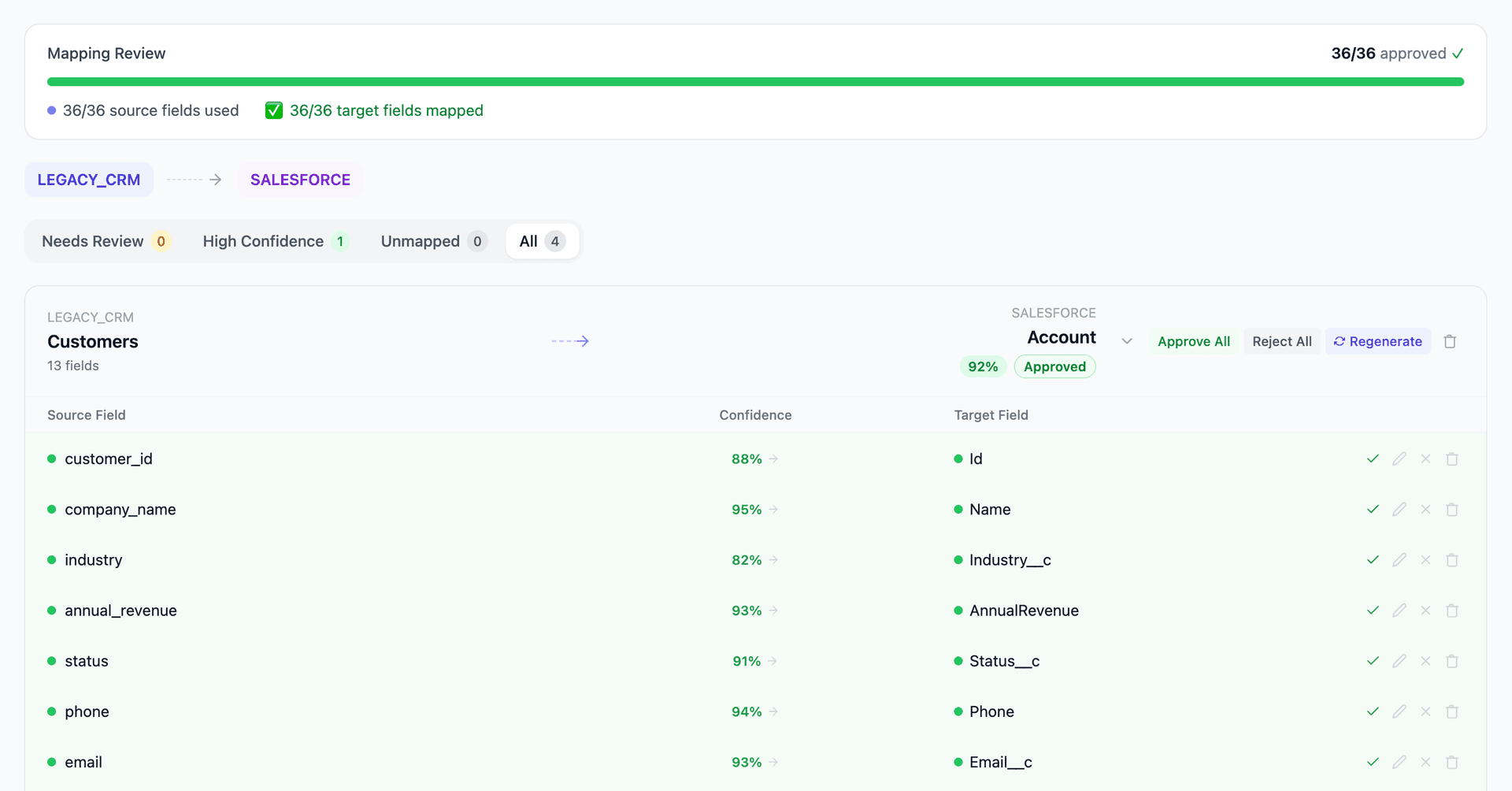
Get your NetSuite to NetSuite mapping analysis — see results in under an hour
Migration timeline: manual vs. Mine
Traditional approach
Timeline
3–9 months
Estimated cost
$150K–800K
Team size
3–8 NetSuite consultants
Typically requires
×Manual field mapping in spreadsheets
×Custom ABAP/SQL extraction scripts
×3–5 mock migration cycles
×Dedicated source system consultants
×Manual reconciliation testing
With Mine
Enterprise benchmarksTimeline
3–6 weeks
Team size
1–3 internal resources
Estimated cost
40–50% less
Included
✓Schema profiling & analysis
✓AI-generated field mappings
✓Transformation SQL
✓Validation & readiness reports
✓Production-ready load files
Common challenges migrating from NetSuite to NetSuite
Chart of accounts reconciliation
Two NetSuite instances have independently numbered charts of accounts. Revenue accounts, COGS accounts, expense categories, and balance sheet accounts all use different numbers and potentially different structures. The target OneWorld account needs a unified COA. Mine generates a side-by-side account comparison and suggests mappings based on account type, name, and balance patterns.
Explore related migrations →Item master deduplication and renumbering
Both instances may sell the same products with different internal IDs, different item names, and different unit of measure configurations. Items that exist in both instances must be deduplicated. Items unique to each instance must be created in the target. Mine uses fuzzy matching on item name, description, UPC, and vendor part number to identify duplicates across instances.
Explore related migrations →Customer and vendor deduplication
Shared customers and vendors exist in both instances with different internal IDs, different custom field values, and different transaction history. Mine identifies duplicate entities using name matching, email domain, address, and tax ID — generating a merge plan with confidence scoring.
Explore related migrations →Custom field and custom record harmonization
Each NetSuite instance has custom fields and custom records built for its specific business processes. Some overlap (both instances might have a 'Customer Tier' field) but use different values. Others exist only in one instance. Mine profiles all custom fields and records in both instances and generates the harmonization plan.
Explore related migrations →Historical transaction migration and financial integrity
Migrating GL journal entries, invoices, bills, and payment records from one instance into a OneWorld subsidiary requires account mapping, period alignment, and balance verification. Opening balances must tie to the acquired company's last financial statements. Mine generates the journal entry transformation with account crosswalk and provides pre/post migration balance validation.
Explore related migrations →NetSuite to NetSuite field mapping — what data moves
12 data objects typically migrated
| Source Object | → | Target Object |
|---|---|---|
| Chart of Accounts (Instance A) | → | Chart of Accounts (OneWorld) |
| Item (Instance A) | → | Item (OneWorld) |
| Customer (Instance A) | → | Customer (OneWorld) |
| Vendor (Instance A) | → | Vendor (OneWorld) |
| Journal Entry (Instance A) | → | Journal Entry (OneWorld Subsidiary) |
| Invoice (Instance A) | → | Invoice (OneWorld Subsidiary) |
| Vendor Bill (Instance A) | → | Vendor Bill (OneWorld Subsidiary) |
| Sales Order (Instance A) | → | Sales Order (OneWorld Subsidiary) |
| Purchase Order (Instance A) | → | Purchase Order (OneWorld Subsidiary) |
| Custom Records (Instance A) | → | Custom Records (OneWorld) |
| Employee (Instance A) | → | Employee (OneWorld Subsidiary) |
| Saved Searches / Reports | → | Requires rebuild |
Typical enterprise migrations include 500K–10M+ records across these objects. Mine handles profiling and mapping at any scale.
The cost of manual NetSuite to NetSuite migration
These consolidation projects typically run 3–9 months with NetSuite implementation partners. The data workstream — chart of accounts mapping, item and customer deduplication, custom field harmonization, and historical transaction migration — is the most complex because it requires both technical schema mapping and business-level decisions about which entity's standards become the target.
Frequently asked questions
Related migration paths
In one enterprise migration, a single field mapping error in customer master data caused $100K in billing discrepancies that went undetected for 6 months.
Mine catches these issues before they reach production.
Built by a team that led SAP, Oracle, and Salesforce data migration programs for Fortune 500 companies at a Big 4 consulting firm. Currently in design partnership with enterprise clients running active migration programs.
Ready to migrate from NetSuite to NetSuite?
Tell us about your migration and we'll show you how Mine can help.
No commitment required. We'll review your migration scope and share a preliminary assessment within 48 hours.
You'll receive a preliminary mapping analysis showing how your source objects map to your target schema, with confidence scores and flagged risk areas.