
Mailchimp to HubSpot Data Migration
Upgrading from Mailchimp to HubSpot? Mine automates the mapping between Mailchimp's audience model and HubSpot's contact-centric CRM — preserving subscribers, tags, campaign history, and engagement data.
Working with enterprise teams on active migration programs
1–2 weeks
to production-ready mappings
40–50%
cost reduction vs. manual migration
90%+
average mapping confidence
Most enterprise migrations start 6+ months behind schedule. Yours doesn't have to.
This guide is for VPs of IT, data architects, and migration leads at companies moving data from Mailchimp to HubSpot — whether you're scoping, planning, or mid-program.
Mailchimp stores marketing data in audiences with subscribers, tags, merge fields, segments, and campaign engagement metrics. HubSpot uses contacts with properties, lists, lifecycle stages, and integrated CRM data. Mine translates Mailchimp's email-marketing-first model to HubSpot's unified marketing-sales-service platform.
Based on enterprise migration programs led by Mine's founding team
Last updated March 2026
How Mine automates your Mailchimp to HubSpot migration
Mine merges multiple Mailchimp audiences into HubSpot's single contact database with deduplication — matching subscribers across audiences by email and preserving audience-specific tags as properties.
Tags are analyzed by usage pattern and converted to the optimal HubSpot structure — segmentation tags become active list criteria, status tags become dropdown properties, and binary tags become checkboxes.
Merge fields are profiled by actual data content (not just Mailchimp's declared type) to determine the correct HubSpot property type for each.
Campaign engagement metrics are summarized at the contact level — total emails received, total opens, last engagement date, engagement score — and loaded as HubSpot custom properties for immediate marketing team use.
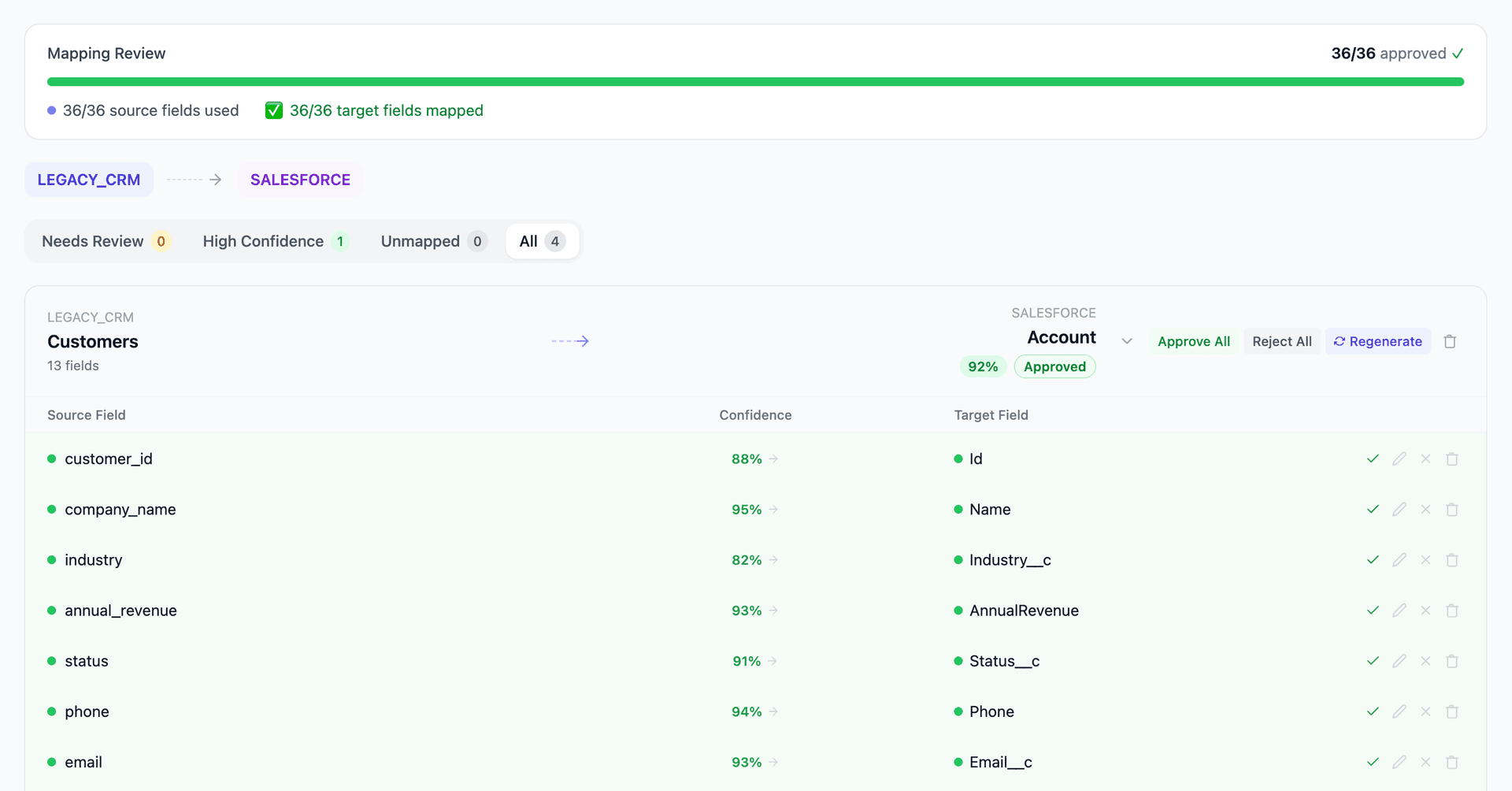
Get your Mailchimp to HubSpot mapping analysis — see results in under an hour
Migration timeline: manual vs. Mine
Traditional approach
Timeline
1–2 months
Estimated cost
$20K–80K
Team size
1 consultant
Typically requires
×Manual field mapping in spreadsheets
×Custom ABAP/SQL extraction scripts
×3–5 mock migration cycles
×Dedicated source system consultants
×Manual reconciliation testing
With Mine
Enterprise benchmarksTimeline
1–2 weeks
Team size
1 internal resource
Estimated cost
40–50% less
Included
✓Schema profiling & analysis
✓AI-generated field mappings
✓Transformation SQL
✓Validation & readiness reports
✓Production-ready load files
Common challenges migrating from Mailchimp to HubSpot
Audience model to contact model
Mailchimp organizes around audiences (separate subscriber lists) while HubSpot uses a single contact database with list segmentation. If you have multiple Mailchimp audiences with overlapping subscribers, they must be merged into HubSpot with deduplication. Audience-specific tags may need to become contact properties.
Explore related migrations →Tags to properties or lists
Mailchimp tags are used for segmentation, automation triggers, and organization. HubSpot doesn't have a direct tag equivalent — tags must become contact properties (dropdown or multi-select), static list memberships, or lifecycle stage assignments. Each tag needs analysis of how it's used.
Explore related migrations →Merge fields to custom properties
Mailchimp's merge fields (FNAME, LNAME, COMPANY, plus custom fields) map to HubSpot contact properties. The merge field data types may not match HubSpot property types — a merge field used as a date picker in Mailchimp needs a HubSpot date property, not a text property.
Explore related migrations →Campaign engagement history
Mailchimp tracks detailed campaign engagement — which emails each subscriber opened, clicked, or bounced. HubSpot can track similar data going forward, but importing historical Mailchimp engagement is limited. Key metrics (total opens, last email date, engagement score) can be preserved as custom properties.
Explore related migrations →Mailchimp to HubSpot field mapping — what data moves
8 data objects typically migrated
| Source Object | → | Target Object |
|---|---|---|
| Subscriber (Active) | → | Contact |
| Subscriber (Unsubscribed) | → | Contact (opted out) |
| Tags | → | Properties / Lists |
| Merge Fields | → | Contact Properties |
| Segments | → | Active Lists |
| Groups | → | Properties (multi-select) |
| Campaign History | → | Custom Properties |
| Audience | → | Contact Database |
Typical enterprise migrations include 500K–10M+ records across these objects. Mine handles profiling and mapping at any scale.
The cost of manual Mailchimp to HubSpot migration
Companies typically use HubSpot's native Mailchimp import tool or manual CSV exports. The tag-to-property translation, segment recreation, and engagement history decisions are where manual effort concentrates.
Frequently asked questions
Related migration paths
In one enterprise migration, a single field mapping error in customer master data caused $100K in billing discrepancies that went undetected for 6 months.
Mine catches these issues before they reach production.
Built by a team that led SAP, Oracle, and Salesforce data migration programs for Fortune 500 companies at a Big 4 consulting firm. Currently in design partnership with enterprise clients running active migration programs.
Ready to migrate from Mailchimp to HubSpot?
Tell us about your migration and we'll show you how Mine can help.
No commitment required. We'll review your migration scope and share a preliminary assessment within 48 hours.
You'll receive a preliminary mapping analysis showing how your source objects map to your target schema, with confidence scores and flagged risk areas.