
Magento to Shopify Data Migration
Migrating your store from Magento to Shopify? Mine automates the product catalog, customer, and order data mapping — preserving variant structures, SEO URLs, and customer purchase history.
Working with enterprise teams on active migration programs
1–3 weeks
to production-ready mappings
40–50%
cost reduction vs. manual migration
90%+
average mapping confidence
Most enterprise migrations start 6+ months behind schedule. Yours doesn't have to.
This guide is for VPs of IT, data architects, and migration leads at companies moving data from Magento to Shopify — whether you're scoping, planning, or mid-program.
Magento uses a complex EAV (Entity-Attribute-Value) database architecture with configurable products, multi-store views, and attribute sets, while Shopify uses a simpler product-variant model with a flat attribute structure. Mine translates Magento's flexible but complex EAV model to Shopify's streamlined commerce architecture — handling the product restructuring that makes this migration technically demanding.
Based on enterprise migration programs led by Mine's founding team
Last updated March 2026
How Mine automates your Magento to Shopify migration
Mine profiles Magento's EAV product data and restructures it for Shopify — converting configurable products to variants, mapping attributes to metafields, and flagging products that exceed Shopify's variant limits.
Category hierarchies are translated to Shopify collections with automated and manual collection rules generated based on Magento's category-product assignments.
SEO URL redirect mapping is generated automatically — every Magento product, category, and CMS page URL gets a 301 redirect to the Shopify equivalent, preserving Google rankings.
Mine validates product data completeness after migration — ensuring all images, variants, pricing, and inventory quantities transferred correctly.
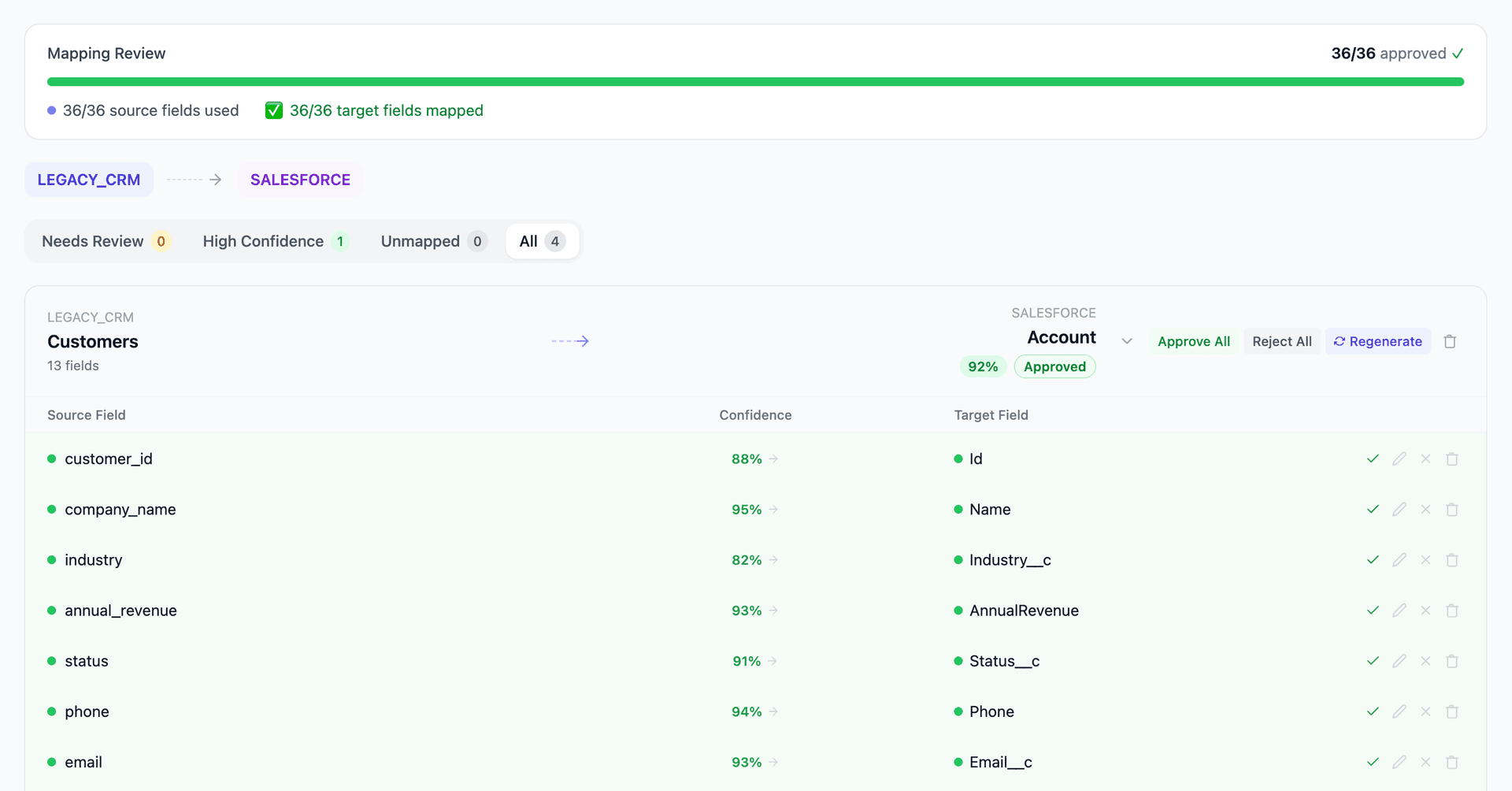
Get your Magento to Shopify mapping analysis — see results in under an hour
Migration timeline: manual vs. Mine
Traditional approach
Timeline
1–3 months
Estimated cost
$20K–100K
Team size
1–2 developers
Typically requires
×Manual field mapping in spreadsheets
×Custom ABAP/SQL extraction scripts
×3–5 mock migration cycles
×Dedicated source system consultants
×Manual reconciliation testing
With Mine
Enterprise benchmarksTimeline
1–3 weeks
Team size
1 internal resource
Estimated cost
40–50% less
Included
✓Schema profiling & analysis
✓AI-generated field mappings
✓Transformation SQL
✓Validation & readiness reports
✓Production-ready load files
Common challenges migrating from Magento to Shopify
EAV architecture to Shopify's flat model
Magento's EAV stores product data across 5+ tables per attribute type. Shopify uses a single product record with a flat attribute structure. Custom attributes in Magento may become Shopify metafields, product tags, or variant options depending on how they're used. The restructuring requires understanding which attributes are display-critical vs. filterable vs. informational.
Explore related migrations →Configurable products to Shopify variants
Magento configurable products have parent items with child simple products, each with its own SKU and inventory. Shopify products have up to 3 variant axes (with up to 100 variants per product). Magento configurations exceeding Shopify's 3-option / 100-variant limits need restructuring — either splitting into multiple Shopify products or using apps for extended variants.
Explore related migrations →SEO URL preservation
Magento and Shopify use different URL structures. Magento: /category/product-name.html. Shopify: /products/product-handle. Losing SEO URLs means losing Google ranking for every product page. The migration must include URL redirect mapping from every Magento URL to its Shopify equivalent.
Explore related migrations →Multi-store to Shopify multi-market
Magento's multi-store views (different websites, stores, store views for regions/languages) don't map directly to Shopify's simpler multi-market structure (Shopify Markets). Complex multi-store setups may require Shopify Plus or separate Shopify stores.
Explore related migrations →Magento to Shopify field mapping — what data moves
10 data objects typically migrated
| Source Object | → | Target Object |
|---|---|---|
| Configurable Product | → | Product with Variants |
| Simple Product | → | Product or Variant |
| Product Attributes | → | Metafields / Tags |
| Category | → | Collection |
| Customer | → | Customer |
| Order | → | Order |
| Review | → | Review (via app) |
| CMS Page | → | Page |
| URL Rewrites | → | URL Redirects |
| Product Images | → | Product Images |
Typical enterprise migrations include 500K–10M+ records across these objects. Mine handles profiling and mapping at any scale.
The cost of manual Magento to Shopify migration
Companies typically use migration apps from the Shopify App Store (LitExtension, Cart2Cart) or custom scripts. These tools handle basic product/customer/order transfer but often lose SEO URLs, custom attributes, and complex product relationships.
Frequently asked questions
In one enterprise migration, a single field mapping error in customer master data caused $100K in billing discrepancies that went undetected for 6 months.
Mine catches these issues before they reach production.
Built by a team that led SAP, Oracle, and Salesforce data migration programs for Fortune 500 companies at a Big 4 consulting firm. Currently in design partnership with enterprise clients running active migration programs.
Ready to migrate from Magento to Shopify?
Tell us about your migration and we'll show you how Mine can help.
No commitment required. We'll review your migration scope and share a preliminary assessment within 48 hours.
You'll receive a preliminary mapping analysis showing how your source objects map to your target schema, with confidence scores and flagged risk areas.