
Freshdesk to HubSpot Data Migration
Consolidating support into HubSpot? Mine automates the mapping between Freshdesk's ticket model and HubSpot's Service Hub — preserving ticket history, custom fields, and customer relationships in a unified CRM-service platform.
Working with enterprise teams on active migration programs
1–3 weeks
to production-ready mappings
40–50%
cost reduction vs. manual migration
90%+
average mapping confidence
Most enterprise migrations start 6+ months behind schedule. Yours doesn't have to.
This guide is for VPs of IT, data architects, and migration leads at companies moving data from Freshdesk to HubSpot — whether you're scoping, planning, or mid-program.
Freshdesk stores support data in tickets with custom fields, tags, canned responses, and automation rules, while HubSpot Service Hub uses tickets with properties, pipelines, and conversation-based engagement tracking tied to HubSpot's CRM. Mine translates Freshdesk's dedicated help desk model to HubSpot's integrated CRM-service architecture automatically.
Based on enterprise migration programs led by Mine's founding team
Last updated March 2026
How Mine automates your Freshdesk to HubSpot migration
Mine deduplicates Freshdesk contacts against existing HubSpot CRM records by email — merging support-specific data into existing HubSpot contacts and creating new records only for contacts that don't already exist in HubSpot.
Custom fields are profiled and mapped to HubSpot ticket properties with type translation — Freshdesk dependent dropdowns become HubSpot property logic, tags become multi-select or dropdown properties.
Ticket conversation threads are preserved as HubSpot timeline activities — customer replies become email activities, internal notes become internal notes, with timestamps maintained.
Mine generates the HubSpot ticket pipeline configuration based on your Freshdesk status usage patterns and maps every historical ticket to the correct pipeline stage.
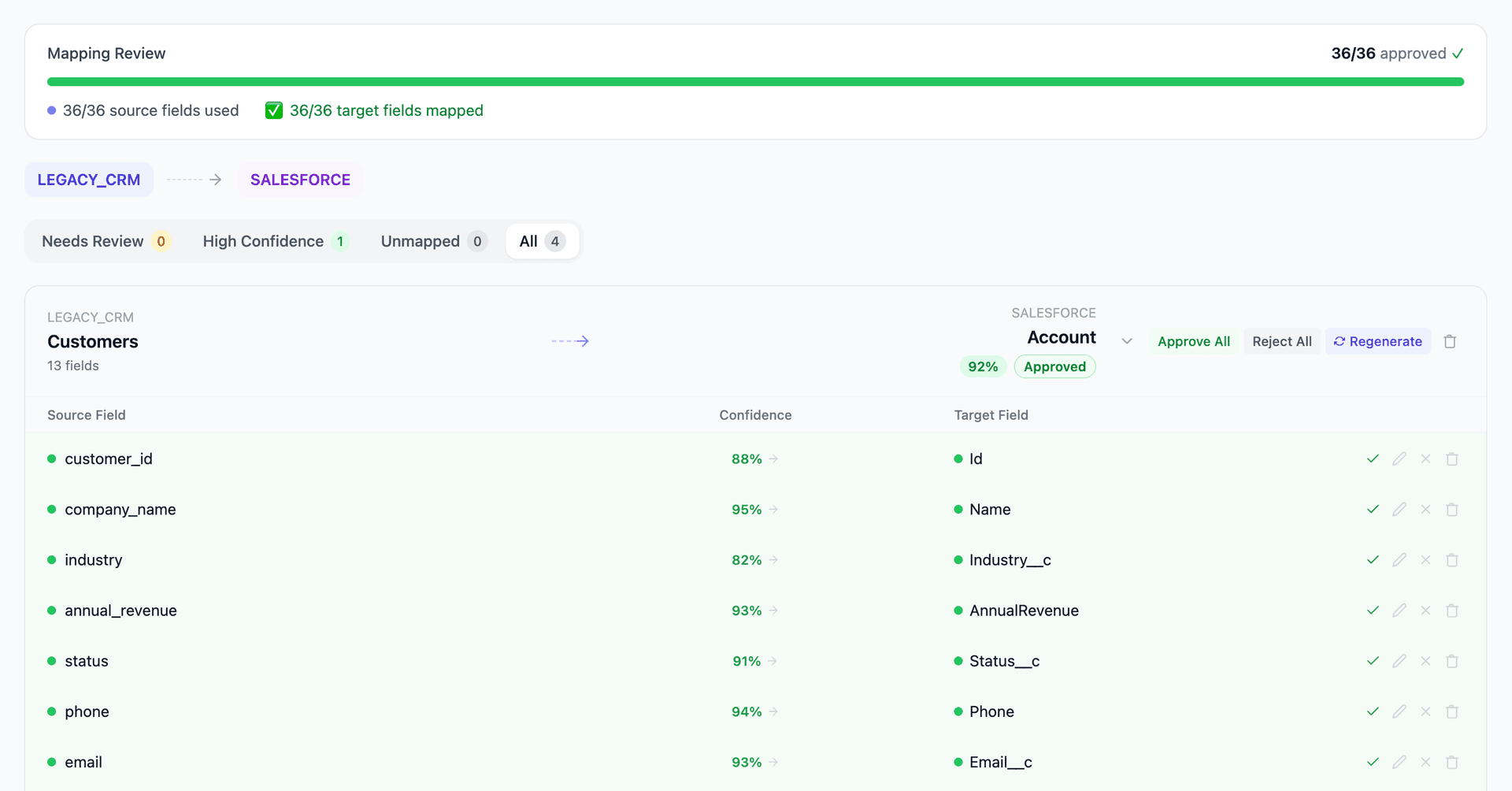
Get your Freshdesk to HubSpot mapping analysis — see results in under an hour
Migration timeline: manual vs. Mine
Traditional approach
Timeline
1–3 months
Estimated cost
$30K–120K
Team size
1–2 consultants
Typically requires
×Manual field mapping in spreadsheets
×Custom ABAP/SQL extraction scripts
×3–5 mock migration cycles
×Dedicated source system consultants
×Manual reconciliation testing
With Mine
Enterprise benchmarksTimeline
1–3 weeks
Team size
1 internal resource
Estimated cost
40–50% less
Included
✓Schema profiling & analysis
✓AI-generated field mappings
✓Transformation SQL
✓Validation & readiness reports
✓Production-ready load files
Common challenges migrating from Freshdesk to HubSpot
Contact deduplication against existing HubSpot CRM data
If you're already using HubSpot for CRM, contacts from Freshdesk may already exist as HubSpot contact records from the sales side. Freshdesk contacts must be matched to existing HubSpot contacts by email to avoid duplicates. Mine identifies matches and merges Freshdesk-specific data (support history, ticket count) into existing HubSpot records.
Explore related migrations →Custom field to HubSpot property translation
Freshdesk custom ticket fields use types that don't always match HubSpot property types. Dependent dropdown fields, nested dropdowns, and checkbox fields need HubSpot equivalents. Tags must become properties since HubSpot tickets don't have native tags. Mine profiles each custom field and recommends the optimal HubSpot property type.
Explore related migrations →Ticket pipeline and status mapping
Freshdesk uses a status model (Open, Pending, Resolved, Closed) with custom statuses possible. HubSpot uses customizable ticket pipelines with stages. The status-to-pipeline-stage mapping requires designing the HubSpot pipeline structure before migration. Mine generates the pipeline configuration based on your Freshdesk status usage.
Explore related migrations →Automation and SLA rebuild
Freshdesk's dispatch rules, observer rules, and SLA policies must be rebuilt in HubSpot using workflows and SLA settings. HubSpot's Service Hub SLA capabilities are less mature than Freshdesk's. Mine documents all automation rules with field references so the HubSpot team can rebuild what's possible and identify gaps.
Explore related migrations →Freshdesk to HubSpot field mapping — what data moves
11 data objects typically migrated
| Source Object | → | Target Object |
|---|---|---|
| Ticket | → | Ticket |
| Ticket Conversation | → | Email / Note activity |
| Contact | → | Contact (deduplicate with CRM) |
| Company | → | Company |
| Agent | → | User / Team member |
| Group | → | Team |
| Custom Fields | → | Ticket Properties |
| Tags | → | Properties / Multi-select |
| KB Article | → | Knowledge Article (Pro+) |
| Canned Response | → | Snippet |
| Satisfaction Rating | → | Custom property |
Typical enterprise migrations include 500K–10M+ records across these objects. Mine handles profiling and mapping at any scale.
The cost of manual Freshdesk to HubSpot migration
Companies typically use HubSpot's native import tool or third-party migration services. The contact deduplication against existing HubSpot CRM data and custom field-to-property translation are where most manual effort goes.
Frequently asked questions
In one enterprise migration, a single field mapping error in customer master data caused $100K in billing discrepancies that went undetected for 6 months.
Mine catches these issues before they reach production.
Built by a team that led SAP, Oracle, and Salesforce data migration programs for Fortune 500 companies at a Big 4 consulting firm. Currently in design partnership with enterprise clients running active migration programs.
Ready to migrate from Freshdesk to HubSpot?
Tell us about your migration and we'll show you how Mine can help.
No commitment required. We'll review your migration scope and share a preliminary assessment within 48 hours.
You'll receive a preliminary mapping analysis showing how your source objects map to your target schema, with confidence scores and flagged risk areas.